Showing posts with label historical novel. Show all posts
Thursday, February 16, 2017
Shadows On the Lake
Inspector Stefania Valenti is called to the mountain pass above Lake Como when the road crew constructing a new road to the Swiss border unearths human remains in the process. What ensues is a matter of political and historical intrigue involving one of the area's most well-known families and villas. The skeleton offers up clues that point to murder, but Inspector Valenti must discover the motives and what the now elderly family members may know about the circumstances surrounding the WWII era death.
I am a fan of mysteries and the fact that this one included some historical intrigue pulled me in from the start. I also enjoyed the chance to travel to Italy in my mind as I read the book. Although the villa and exact details of the town have been fictionalized, I did hop on the internet and do a little exploring of the mountains that form the border between Italy and Switzerland as a way of getting into the setting.
I found Inspector Valenti an entirely believable character along with those around her. To some extent the characters fall into the expected roles of any detective/mystery novel: the no-nonsense, "get it done" chief; the eagle-eyed inspector who doesn't miss a detail and has the uncanny ability to link details together (sometimes with the help of equally capable peers), and the underling officers who help out with some of the leg work. Add to this a blooming romantic connection, an ex-husband, and Valenti's school-aged daughter and that rounds out the main cadre of characters.
Although set in the present day, I enjoyed the connection back to World War II days: smuggling Jews across borders, worries over fascism and communism, etc. This made Valenti's quest for justice for the victim a cause I think anyone would want to see through to the conclusion.
The book was a quick, enjoyable read which I would recommend to anyone who enjoys a mystery or detective novel. If it is a new genre to you, this is a good place to start! My thanks to the publisher for the ARC I received for free in exchange for this honest review.
From the Publisher . . .
A new atmospheric Italian mystery novel set in Lake Como, introducing the clever and captivating Inspector Stefania Valenti.
During the construction of a new road to the Swiss border in the mountains above Lake Como, the remains of a young man are unearthed on the powerful Cappelletti family’s property. On the case is Stefania Valenti, forty-five, divorced with a young daughter, and a brilliant, determined police inspector.
Her investigation takes her back to World War II and deep into the history of the region, a place that during the war attracted smugglers, deserters, secret agents, and fleeing Jews. Steeped in the beautiful atmosphere of Northern Italy, Valenti’s investigation brings to light a family’s secret, a tragic romance, and reveals a fascinating piece of Italian history.
Sunday, January 10, 2016
Tromping Through Poland with Anna and the Swallow Man
I had the good fortune of reading Gavriel Savit’s new book, Anna and the Swallow Man. It is the compelling tale of a young girl named Anna (age 7 as the story opens) who’s father goes off to a meeting at work one day and never returns.
It happens that Anna’s father is a linguistics professor at a Polish university and Germany has invaded as WW II is under way. The man who was charged with looking after her for a couple hours abandons her the next morning at her apartment building where Anna is locked out of the empty quarters. She does her best to wait, but hunger and fear set in and Anna makes her way back to the street in front of the shop where her father left her. There she encounters the one person willing to acknowledge her presence, the Swallow Man.
This man speaks many languages like her father. He also has the ability to speak to birds. And he takes Anna under wing and introduces her to a at of survival through the unimaginable horrors of war. I enjoyed this book. It was presented as a book for those who liked The Book Thief. While it’s true the two have similar settings, the two books felt completely different to me. It is a quick read, easily done in a day. It left me with a broader sense of unease and a bit of dissatisfaction with the ending.
Warning, spoilers to come.
It became obvious that the Swallow Man was hiding his identity not only from Anna, but from the world at large because he had some scientific knowledge that others might want. Adult readers know that this will have something to do with nuclear weapons development.
I was interested in what happened to the Swallow Man when his pills ran out. I did a Web search on potassium iodide and discovered it is used when people have been exposed to radiation, however in my searching this did not seem to explain his mental confusion and descent into madness.
Also, I wonder about the arrangement the Swallow Man makes at the end that helps Anna to escape in the boat. (At least I am assuming it’s an escape. I didn’t look at maps to see what islands might be off Polish shores and then research to see if that would have been a sanctuary for Anna or not.)
My questions and concerns about details like these, however, simply show that Savit has given readers plenty to consider in reading the book. If you get the chance to read this book, I would love to hear what you think of it! My thanks to Alfred A. Knopf publishing for the ARE I received and the opportunity to review the book!
From the Publisher . . .
Kraków, 1939. A million marching soldiers and a thousand barking dogs. This is no place to grow up. Anna Łania is just seven years old when the Germans take her father, a linguistics professor, during their purge of intellectuals in Poland. She’s alone.
And then Anna meets the Swallow Man. He is a mystery, strange and tall, a skilled deceiver with more than a little magic up his sleeve. And when the soldiers in the streets look at him, they see what he wants them to see.
The Swallow Man is not Anna’s father—she knows that very well—but she also knows that, like her father, he’s in danger of being taken, and like her father, he has a gift for languages: Polish, Russian, German, Yiddish, even Bird. When he summons a bright, beautiful swallow down to his hand to stop her from crying, Anna is entranced. She follows him into the wilderness.
Over the course of their travels together, Anna and the Swallow Man will dodge bombs, tame soldiers, and even, despite their better judgment, make a friend. But in a world gone mad, everything can prove dangerous. Even the Swallow Man.
Destined to become a classic, Gavriel Savit’s stunning debut reveals life’s hardest lessons while celebrating its miraculous possibilities.
Tuesday, June 9, 2015
The Ghost Bride
I found this novel very engaging! I love reading stories set Asia, and the fact that it is historic adds another level of intrigue for me. Now add the element of spirits, ghosts, and afterlife beliefs and I'm all in!
Choo's writing style is evocative yet accessible. She engages her readers and expands our horizons on many levels. I was wrapped up in Li Lan's fate, the choices she made and their implications, and how everything was going to unfold.
If you enjoy ghost stories, romance, historical novels, exploring the beliefs of other cultures, coming of age stories, strong female protagonists, and supernatural beings, you will love The Ghost Bride by Yangsze Choo. I know I did!
From the Publisher . . .
A wondrous coming-of-age story infused with Chinese folklore, romantic intrigue, adventure, and fascinating, dreamlike twists.
Malaya, 1893 Li Lan, the daughter of a genteel but bankrupt Chinese family, has few prospects. But fate intervenes when she receives a proposal from the wealthy and powerful Lim family. They want her to become a ghost bride for the family's only son, who died under mysterious circumstances. Rarely practiced, ghost marriages are often meant to placate a restless spirit. Such a union would guarantee Li Lan a comfortable home for the rest of her days, but at what cost?
As she reluctantly considers the offer, Li Lan is unwillingly drawn into the shadowy parallel world of the Chinese afterlife, with its ghost cities and vengeful spirits. There Li Lan must uncover the Lim family's darkest secrets—and the truth about her own family—before she is trapped in this ghostly world forever.
About the Author . . .
Yangsze Choo is a fourth-generation Malaysian of Chinese descent. She lives in California with her husband and their two children, and loves to eat and read (often at the same time).
From Barnes & Noble: A Conversation with Yangsze Choo, Author of The Ghost Bride
The Ghost Bride centers on a girl who marries the ghost of a wealthy family's recently deceased son. Can you please explain the concept of a "ghost marriage"? When did you first become intrigued by this practice?
I think I was vaguely aware of this practice as a child. My grandmother lived in a small town in Malaysia opposite an old cinema that often showed scary Chinese movies. We children were not allowed to go and watch them, although from the front window we could see people lining up to go in. I remember the gigantic cinema posters that would cover the billboard in front. In those days, they were all hand painted so that they looked even more lurid - both fascinating and forbidden to us!
The folk tradition of marriages to ghosts, or between ghosts, usually occurred in order to placate spirits or repair familial relations. There are a number of allusions to it in Chinese literature, but its roots seem to lie in ancestor worship. Matches were sometimes made between two deceased persons, with the families on both sides recognizing it as a tie between them. However, there were other cases when a living person was married to the dead. These tended to be the fulfillment of a dying sweetheart's wish, or to give the rank of wife to a concubine who had borne a son. Sometimes, an impoverished girl was taken into a household as a widow in order to perform the ancestral rites for a man who died without a wife or descendants. This is the case for Li Lan, the main character in my book.
More recently, however, one of the things that sparked this novel was a sentence in an old newspaper article. While researching another book I was writing, I happened to go through the archives of our local Malaysian newspaper and found a brief mention of spirit marriages that offhandedly declared them "increasingly rare." At first, I wondered what this referred to, and then I realized that it must be the folk superstition of marriages to the dead. This was so intriguing that I ended up putting aside my first book to write this one instead.
The Ghost Bride delves deeply into the complex world of the afterlife as it's understood in Chinese culture. In what ways does this supernatural element compare to fantasy, and in what ways is it different?
There's a long Chinese literary tradition of tales set in the blurred borderline between spirits and humans, where beautiful women turn out to be foxes, and the afterlife is run like a monstrous parody of Imperial Chinese bureaucracy. When I was a child, I loved reading such stories and was always intensely curious, imagining if these things actually happened. How would you feel if the pretty girl you picked up had no feet, or the palace you visited was actually a beehive?
In this sense, it is fantasy. A very rich and curious Chinese mythology that I'd love to introduce readers to. In fact, when I was growing up, there were lots of old comic books about swordsmen who could fly, had amazing powers, and battled with deities. I don't know where these comics came from - possibly Hong Kong? They were thin, cheaply printed, and had black and white illustrations of old fashioned scholars and heavenly maidens. The ink came off on your hands and had a distinctive smell. I remember struggling to read the more complicated Chinese characters, and even painstakingly looking them up so that I could continue the story. My textbooks at school were never as interesting!
At the same time, my book is also concerned with how these supernatural beliefs are part of the everyday life of the characters. The Chinese concept of the afterlife, with its elements of Buddhism and Taoism mixed with folk religion, is taken quite seriously and still practiced today. For example, the burning of paper effigies as offerings to the dead, and the idea that the afterlife still requires pocket money, cars, and even modern day offerings such as paper iPhones and Gameboys. On a recent trip to Singapore, I noticed that there were even paper replica chickens sold in sets of three and realistically rendered so that you could tell what flavors they were (plain boiled, soy sauce, and roast).
How is The Ghost Bride similar and/or different from the stories you were told when you were young?
Most of the classic Chinese literary stories about ghosts are actually about young men, usually scholars, to whom all these strange things happened. The archetype would be "Once, there was a poor scholar, who was studying alone at night when there was a knock on the door..." Of course, he opens it to find a beautiful girl who turns out to be either a ghost, a fox, or a flower spirit. All sorts of trials ensue, usually with the not-so-subtle warning that you shouldn't be tempted away from your studies!
In my case, I wanted to tell a story from the point of view of a girl. Respectable women, even in late 1890s colonial Malaya, still had fairly restrictive lives. I was captivated with the idea of parallel worlds. You see it in the world of the living vs. the elaborate Chinese afterlife, where there are ghostly mansions made of burned paper offerings, and also in the way that the main character Li Lan develops as she moves from being alive to being partially dead herself. Despite the misery of the second situation, I think it's interesting that she's far freer wandering around in the spirit world than she ever is in the real world.
How do you feel your lead character, Li Lan, conforms to and breaks some of the expectations of her in her time?
That's a great question, because it sometimes bothers me when historical characters have completely modern sensibilities. I think it's natural that Li Lan should be concerned with the conventions and aspirations of her time. She understands very well that it's important for her to get married and not only that, but to make the best match possible. It reminds me of Jane Austen, where all the women are deeply concerned about marriage. There's no suggestion that Elizabeth Bennett desires, for example, the right to vote. She (and her mother and sisters) are focused on marrying well because it has immediate ramifications for their lives.
At the same time, Li Lan is a girl who wants to travel. She wants to visit other countries and see new sights, but she's hampered by social and financial restraints. I thought about those incredibly detailed 19th-century armchair traveler's books like Swiss Family Robinson and 20,000 Leagues Under the Sea, which were written for people who had no chance to go on such voyages. There was probably a real hunger for such experiences that couldn't be satisfied even fifty, let alone a hundred years ago. In Li Lan's case, she gets her wish but her travels turn out to be to the shadowy Chinese afterworld, in the grey border between spirits and humans. It's a terrifying place, yet full of strange beauty.
You have an amazing blog where you talk about your writing process, being a mom and wife, and all about your life as a foodie. Did research for The Ghost Bride introduce you to any new favorite foods?
Oh dear, I was forced to write large sections of the book late at night, because it was the only time that my kids weren't charging around the house. Unfortunately, it was also when I would start feeling terribly hungry. There were sections of the book that we had to remove during editing because they were just descriptions of food. Glossy fried rice. Succulent cockles dipped in chili sauce and lime juice. Ikan pari (skate) grilled in banana leaves over a smoky charcoal fire.
Since I was writing about colonial Malaya in the 1890s, I spent a lot of time thinking about the sort of food that I'd eaten during my childhood. Women in those days spent most of their time in the kitchen, probably because they led these constrained lives. I remember flipping through my mum's old cookbooks and finding a recipe for duck that involved deboning it, stuffing it and doing all sorts of complicated things. When I got to the bit that said "the next day, take the duck..." I gave up.
That's not to say that I don't want to eat that sort of time-consuming cuisine. I do! Just as much as I want to eat noodles that have been flash-fried in a cast-iron wok, preferably over a roaring gas inferno. But since I couldn't get hold of any of this at 11 p.m. at night, I ate a lot of dark chocolate and Manchego cheese instead.
You've mentioned in other interviews that you were researching another book when you became inspired to write this one. Are you back to work on a second novel and if so, does it also delve into Chinese culture?
I'm currently at work on a second novel about sacred tigers, although I'm a bit stumped right now. That's the problem with writing by the seat of your pants. It's either very good going, or it's horrible. This book is also set in colonial Malaya, but in the 1920s instead. I think I still have a lot of Chinese and Southeast Asian stories to tell, as this part of the world is very dear to me and I feel that I can write authentically about it.
Who have you discovered lately?
I just finished a book by Yoko Ogawa, called Revenge: Eleven Dark Tales. They are beautifully creepy short stories, in which the protagonist in one tale becomes a bystander in another so that all the stories are linked in the end. It's the kind of book that makes you want to rush out and write your own take on, for example, carrots that look like human hands.
Another book that I love is Viktor Pelevin's The Sacred Book of the Werewolf, which (contrary to appearances) is not a zombie thriller. Instead, it's a bitingly funny satire about the Russian oligarchy and the oil industry. I keep telling people it's brilliant, combining elements of Russian folktales with Wong Kar Wai's movies, but the words "satire" and "oligarchy" seem to put them off for some reason!
Thursday, April 16, 2015
Safekeeping
Random characters brought together through time and place, their lives woven together despite their vast differences, as each of them searches for meaning amidst the impermanence of life. This is the center thread that beautifully ties Jessamyn Hope's novel, Safekeeping, together.
Hope does a wonderful job of character development. I came to truly care for the people I encountered throughout the novel. I desperately wanted Adam to succeed in his quest to find Dagmar and give her the brooch. I hoped Claudette would find wholeness (or at least normalcy!). I saw the chink in Ziva's self-defense. I sensed the desperation in Ulya's need for a new life. It was quite the journey to walk through their highs and lows alongside them!
Having heard of the kibbutz, though not knowing a lot about the history of the movement, I thought that setting the novel there in the 1990's (for the most part) was brilliant. The flashbacks that Ziva, one of the founding members of the kibbutz, has that fill in some of the history of the Zionist movement from the 1940's and the efforts to form Israel in the decades that followed provide great context. Extending the boundaries of the setting's time all the way back to the 1300's as well as to the current day were the icing on the cake. (Although it is still chilling to be reminded of the brutal treatment of genocide, no matter the century in which it takes place.)
I also enjoyed that this novel had various components to it, such as mystery, drama, character study, etc. This lends an added depth to the novel which drew me in immediately. (Again, the tension of the setting--the Middle East with the Israeli/Arab conflicts added to this as well.) There was also a bit of forlorn melancholy lurking throughout as some characters realized that their way of life was coming to an end. For some, it was a loss. For others, it was a new beginning. And that is how life is: full of both.
If you enjoy novels with rich characters and interesting settings, a bit of mystery, historical connections, and thinking about the meaning of life, this is a novel you'll not want to miss. Book clubs will find a plethora of topics to dive into discussion over!
Thank you to Fig Tree Books LLC for the ARC I received in exchange for this review!
From the Publisher . . .
Jessamyn Hope’s Safekeeping is a profound and moving novel about love, the inevitability of loss, and the courage it takes to keep starting over.
It’s 1994 and Adam, a drug addict from New York City, arrives at a kibbutz in Israel with a medieval sapphire brooch. To make up for a past crime, he needs to get the priceless heirloom to a woman his grandfather loved when he was a Holocaust refugee on the kibbutz fifty years earlier.
There Adam joins other troubled people trying to turn their lives around: Ulya, the ambitious and beautiful Soviet émigré; Farid, the lovelorn Palestinian farmhand; Claudette, the French Canadian Catholic with OCD; Ofir, the Israeli teenager wounded in a bus bombing; and Ziva, the old Zionist Socialist firebrand who founded the kibbutz. By the end of that summer, through their charged relationships with one another, they each get their last chance at redemption.
In the middle of this web glows the magnificent sapphire brooch with its perilous history spanning three continents and seven centuries. With insight and beauty, Safekeeping tackles that most human of questions: how can we expect to find meaning and happiness when we know that nothing lasts?
About the Author . . .
Jessamyn Hope grew up in Montreal and lived in Israel before moving to New York City. Her debut novel SAFKEEPING comes out June 2015. Her fiction and memoirs have appeared in Ploughshares, Five Points, Colorado Review, Descant, and PRISM international, among other literary magazines. She was the Susannah McCorkle Scholar in Fiction at the 2012 Sewanee Writers' Conference and has an M.F.A. in creative writing from Sarah Lawrence College. Learn more at jessamynhope.com.
Thursday, October 17, 2013
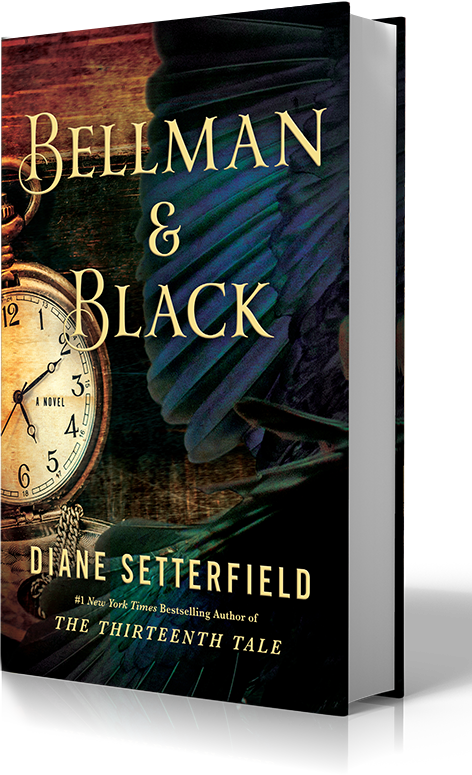
Bellman & Black
Bellman and Black by Diane Setterfield tells the story of William Bellman, born in England during what feels like the Victorian era. (Funny, I'm not sure the book actually listed any dates, although I could have overlooked it.)
The story opens with a scenes from Bellman's youth. He becomes a leader among his peers when he hits a rook (crow/raven) from a long distance using his slingshot. From that moment on it seems William is the golden boy on whom good fortune smiles.
Bellman is the nephew of the town's biggest industry, a woolen mill. His cousin has no interest in taking over the family business and so William is introduced to the day in, day out working of the mill. He flourishes in the environment bringing with him new ideas, improvements and increased business for the mill. He marries and has a family. It seems William Bellman has the Midas touch.
He does suffer losses along the way. A friend passes. His mother dies. And at each of these occasions, Bellman espies a mysterious man in black whose presence in the graveyard unsettles him.
When a deadly disease ravages his town and family, killing his youngest children, his wife, and hovering over his eldest daughter, Bellman strikes up a desperate conversation with this mysterious Mr. Black in the dark, delirium of night among the tombstones. Ready to sacrifice himself to spare his daughter, Bellman makes a deal.
And that will bring you to the half-way point of the book.
What happens in the second half is at once fascinating (in looking back at one possibility for how the funeral industry may have gotten its start) and appalling (in what happens to the character of William Bellman).
Setterfield's writing is engaging and entertaining. She intersperses chapters (titled by ampersands!) which talk about the nature of rooks and the naming of groups of them. These chapters encourage readers to think about the role that the birds are playing throughout the rest of the story about William Bellman.
Because the book itself says it is "A Ghost Story"--I was expecting something a little more paranormal and a little less philosophical. In that respect, I was a tad disappointed. However, I think readers will find the novel engaging and will want to discover what is the meaning(s) of the title and how William Bellman's life unfolds.
Coming Next: Children of the Jacaranda Tree by Sahar Delijani
Labels:
Bellman,
Black,
England,
fiction,
historical novel,
rooks,
Setterfield,
Victorian
Sunday, September 29, 2013
Necessary Lies
Necessary Lies by Diane Chamberlain is a powerfully moving story set in rural North Carolina in 1960. It tells the story of a young woman, Jane, newly married to a pediatrician, who wants her own career helping others. She has recently graduated from Woman's College and gets a job as a social worker in the welfare office overseeing clients in a rural, poverty stricken county near Raleigh.
On the job she meets the Hart family: two teenage girls being raised by their grandmother in a small tenant house on a tobacco farm owned by Davison Gardiner. The younger of the two, Ivy, basically oversees the household as her aging grandmother has serious health issues and her feeble minded sister, Mary Ella, has a two-year old son that needs looking after.
Jane is warned by her superior, Charlotte Werkmann, not to get overly-invested or personally involved with her clients. The hallmark of good, effective social work among the county's population is to stay detached in order to keep the proper perspective on the needs of the children and families she serves.
Jane learns that North Carolina's "eugenics" program--the routine sterilization of not just those who are institutionalized, but any and all who fall below an IQ of 70, those who have epilepsy, or those who are deemed unlikely to ever get off the welfare rolls--has already sterilized Mary Ella without her knowledge or consent, and now have their sights on doing the same to younger sister, Ivy. The better she gets to know the Hart girls, the more outraged she becomes at the system which seems to offer these girls no choice.
What ensues is the story of lives forever changed by one person's stubborn challenge to a system which may or may not serve the best interests of those most vulnerable in society.
Some of the things in Chamberlain's book shock my sense of what it means to be a woman in 2013 in the United States. The fact that a doctor would not write a birth control prescription for her unless she had a signed permission note from her husband felt like a huge slap in the face. Yet, I have no doubt that thinking existed in the past. How far we have come!
It was also quite a shock to realize that involuntary sterilization of people occurred at such rates! I knew that it has happened to people who lived in institutions, such as the severely mentally handicapped and those in psychiatric care in the past. I assumed that these procedures always had the ok of nearest living relatives or guardians.
To discover in the Afterword that 7,000 people in the state of North Carolina alone, into the 1970s!, were being sterilized based on intelligence, their use of the welfare system, or even because they were epileptic remains shocking to say the least!
I read Necessary Lies in a matter of hours because it was such compelling reading. I felt myself getting entwined in the lives of the characters. I also really enjoyed Chamberlain's technique of writing every-other chapter from Jane and Ivy's perspectives.
I would highly recommend reading Necessary Lies. Chamberlain has done an outstanding job depicting the time and place and presenting us with characters you feel are standing right behind you, looking over your shoulder as you read. Get your book club to consider this one--you will find a plethora of things to discuss!!
Tuesday, July 23, 2013
A Different Sun
The only disappointing thing about A Different Sun by Elaine Orr was that it ended!
Orr's characters become close friends to the reader in this vivid tale of a missionary's wife who travels with him to Africa in the 1850's. Full of evocative descriptions and emotions, I found myself compelled to keep reading in order to find out what would happen to Emma and the African "family" and friends she makes along her journey. When the novel ended in what felt like mid-stream, I wanted more.
What happens to the young couple? To their child? The future is left up to the reader's imagination. What you come to know of Emma, Henry, and the others will help you as you imagine the way their lives unfold--perhaps that is enough.
I find it especially interesting that Orr's book is based upon the actual, historic diaries of a young woman. I love novels like this that hearken back to real world experiences and people. I was fascinated to watch Emma's inner strength blossom in each situation she encountered. Although I have kept journals off and on throughout my life, I doubt that therein lies anything worthy of a novel in the future. This book makes me ponder the differences between our modern every-day lives and choices and those of the generations before us who lived in such very different circumstances.
I'm thankful to Goodreads' FirstReads for the ARC I won that allowed me to read this wonderful novel. I will recommend this to my book club as a future selection!
Subscribe to:
Posts (Atom)