Tuesday, January 14, 2014


Unless you have the good fortune to live in a culinary mecca and have the means to indulge in the latest gastronomic trends and adventures, your food experiences are likely fairly standard fare. Hoffman and Wise offer those of us in the latter situation a ticket to experience something new in their cookbook Bold: A Cookbook of Big Flavors.

Alongside the enticing & titillating recipes, Hoffman and Wise offer readers interesting bits of regional food histories, facts about the ingredients we may take for granted, and vignettes of the people who have helped form the widely varied foods and ethnic traditions that are encompassed by American Cuisine.

I can't wait to try Chicken Breasts in Coffee, Vanilla, Sundried Tomato, and Currant Cream; Shrimp in Lemongrass Coconut Broth; Roasted Pears with Rum Caramel Sauce and Chocolate Sauce; and Date, Feta, and Prosciutto Roll-ups. Many of the flavor combinations are exciting twists on traditional dishes. Most recipes include ingredients readily available even in Fort Dodge, Iowa. I am thrilled with my copy and highly recommend this cookbook for everyone wanting to break out of their dietary rut--try Bold!

Thursday, December 5, 2013

After I'm Gone


I love a good mystery, so the description of Laura Lipmann’s new novel, After I’m Gone, grabbed me from the get-go:

Dead is dead. Missing is gone.

When Felix Brewer meets nineteen-year-old Bernadette "Bambi" Gottschalk at a Valentine's Day dance in 1959, he charms her with wild promises, some of which he actually keeps. Thanks to his lucrative—if not all legal—businesses, she and their three little girls live in luxury. But on the Fourth of July in 1976, Bambi's comfortable world implodes when Felix, facing prison, vanishes.

Though Bambi has no idea where her husband—or his money—might be, she suspects one woman does: his devoted young mistress, Julie. When Julie disappears ten years to the day after Felix went on the lam, everyone assumes she's left to join her old lover—until her remains are discovered in a secluded park.

Now, twenty-six years later, Roberto "Sandy" Sanchez, a retired Baltimore detective working cold cases for some extra cash, is investigating her murder. What he discovers is a tangled web of bitterness, jealousy, resentment, greed, and longing stretching over five decades. And at its center is the man who, though long gone, has never been forgotten by the five women who loved him: the enigmatic Felix Brewer.

Felix Brewer left five women behind. Now there are four. Does at least one of them know the truth?

The novel is written in a way that I always enjoy: chapters going back and forth between glances back at historical moments which gradually begin to lay out the case and shed light on the characters/suspects and present day experiences and encounters by the sleuth on the case (in this case, Roberto “Sandy” Sanchez.)

At about the half-way point in the novel I smugly assumed I had figured out “who dunit.” As the next few chapters unfolded I grew more and more confident in my brilliant deduction and knowledge of human character. I had pinpointed exactly the person who had motive, means and opportunity.

Or so I thought. I must hand it to Lipmann, I fell for the obvious hook, line and sinker! She got me with a twist, and I’m so glad I was wrong. I will recommend this novel to all my friends and to Laura Lipmann I say, “Bravo!” I can’t wait to read more of her work.

Thursday, October 31, 2013

Children of the Jacaranda Tree


Many thanks to GoodReads' First Reads for the opportunity to read this book!

I enjoyed this book. Sometimes you think you have learned about a piece of the world and its history only to discover you did not really have any clue, or that a huge part of the picture had been missing. That is how I feel about Iran after reading Delijani's heart-rending novel. The depiction of what happened to so many Iranians during their national upheaval in the 1980s (and again more recently) makes one have to stop and ponder what it truly would be like to have your family suddenly torn asunder over political ideals and philosophies. (Torn asunder to the point of no return in many cases as men and women were executed and disappeared without at trace.) I cannot say which character in the book I think my own reactions/life would mirror in that situation as it so unfathomable to me. I am glad, however, I was taken on the journey to examine this because I know it is such a reality for so many people around the world.

I had a bit of a hard time keeping the characters straight simply from my own unfamiliarity with Iranian/Muslim names. There were a few times I was reading and did not realize the characters were related simply because I had not kept the names straight.

I would definitely recommend this book, especially if you are a fan of historical novels or enjoy learning about cultures other than your own. You will learn a lot and enjoy getting to know the people in this novel!

Thursday, October 17, 2013

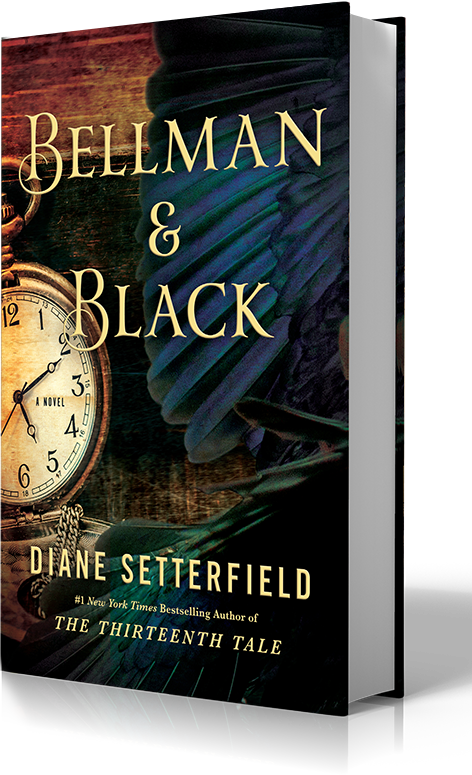
Bellman & Black


Bellman and Black by Diane Setterfield tells the story of William Bellman, born in England during what feels like the Victorian era. (Funny, I'm not sure the book actually listed any dates, although I could have overlooked it.)

The story opens with a scenes from Bellman's youth. He becomes a leader among his peers when he hits a rook (crow/raven) from a long distance using his slingshot. From that moment on it seems William is the golden boy on whom good fortune smiles.

Bellman is the nephew of the town's biggest industry, a woolen mill. His cousin has no interest in taking over the family business and so William is introduced to the day in, day out working of the mill. He flourishes in the environment bringing with him new ideas, improvements and increased business for the mill. He marries and has a family. It seems William Bellman has the Midas touch.

He does suffer losses along the way. A friend passes. His mother dies. And at each of these occasions, Bellman espies a mysterious man in black whose presence in the graveyard unsettles him.

When a deadly disease ravages his town and family, killing his youngest children, his wife, and hovering over his eldest daughter, Bellman strikes up a desperate conversation with this mysterious Mr. Black in the dark, delirium of night among the tombstones. Ready to sacrifice himself to spare his daughter, Bellman makes a deal.

And that will bring you to the half-way point of the book.

What happens in the second half is at once fascinating (in looking back at one possibility for how the funeral industry may have gotten its start) and appalling (in what happens to the character of William Bellman).

Setterfield's writing is engaging and entertaining. She intersperses chapters (titled by ampersands!) which talk about the nature of rooks and the naming of groups of them. These chapters encourage readers to think about the role that the birds are playing throughout the rest of the story about William Bellman.

Because the book itself says it is "A Ghost Story"--I was expecting something a little more paranormal and a little less philosophical. In that respect, I was a tad disappointed. However, I think readers will find the novel engaging and will want to discover what is the meaning(s) of the title and how William Bellman's life unfolds.

Coming Next: Children of the Jacaranda Tree by Sahar Delijani

Sunday, September 29, 2013

Necessary Lies


Necessary Lies by Diane Chamberlain is a powerfully moving story set in rural North Carolina in 1960. It tells the story of a young woman, Jane, newly married to a pediatrician, who wants her own career helping others. She has recently graduated from Woman's College and gets a job as a social worker in the welfare office overseeing clients in a rural, poverty stricken county near Raleigh.

On the job she meets the Hart family: two teenage girls being raised by their grandmother in a small tenant house on a tobacco farm owned by Davison Gardiner. The younger of the two, Ivy, basically oversees the household as her aging grandmother has serious health issues and her feeble minded sister, Mary Ella, has a two-year old son that needs looking after.

Jane is warned by her superior, Charlotte Werkmann, not to get overly-invested or personally involved with her clients. The hallmark of good, effective social work among the county's population is to stay detached in order to keep the proper perspective on the needs of the children and families she serves.

Jane learns that North Carolina's "eugenics" program--the routine sterilization of not just those who are institutionalized, but any and all who fall below an IQ of 70, those who have epilepsy, or those who are deemed unlikely to ever get off the welfare rolls--has already sterilized Mary Ella without her knowledge or consent, and now have their sights on doing the same to younger sister, Ivy. The better she gets to know the Hart girls, the more outraged she becomes at the system which seems to offer these girls no choice.

What ensues is the story of lives forever changed by one person's stubborn challenge to a system which may or may not serve the best interests of those most vulnerable in society.

Some of the things in Chamberlain's book shock my sense of what it means to be a woman in 2013 in the United States. The fact that a doctor would not write a birth control prescription for her unless she had a signed permission note from her husband felt like a huge slap in the face. Yet, I have no doubt that thinking existed in the past. How far we have come!

It was also quite a shock to realize that involuntary sterilization of people occurred at such rates! I knew that it has happened to people who lived in institutions, such as the severely mentally handicapped and those in psychiatric care in the past. I assumed that these procedures always had the ok of nearest living relatives or guardians.

To discover in the Afterword that 7,000 people in the state of North Carolina alone, into the 1970s!, were being sterilized based on intelligence, their use of the welfare system, or even because they were epileptic remains shocking to say the least!

I read Necessary Lies in a matter of hours because it was such compelling reading. I felt myself getting entwined in the lives of the characters. I also really enjoyed Chamberlain's technique of writing every-other chapter from Jane and Ivy's perspectives.

I would highly recommend reading Necessary Lies. Chamberlain has done an outstanding job depicting the time and place and presenting us with characters you feel are standing right behind you, looking over your shoulder as you read. Get your book club to consider this one--you will find a plethora of things to discuss!!

Tuesday, September 17, 2013

Stark, Vivid, Heart Rending Reads

Two books I have read in the past few months may strike some readers as bleak.

Yesterday I finished Burial Rites by Hannah Kent.


What do you think of convicted killers? How do you feel about public execution? How would you like a convicted killer who's been sentenced to death living with your family?

Agnes Magnussdottir knows death is coming for her. What she doesn't know is when.

Sentenced to death for taking part in the killing of two men at a remote farmstead in Iceland in 1828, Agnes is sent to live out her remaining days (the number of which has yet to be determined) with the family of a government official at the Kornsa farmstead. Kent's novel narrates the final months of Agnes' life: her conversations with the priest she has chosen to offer her spiritual guidance and the women who inhabit the same space and shape her last days.

Agnes feels that her voice, her story were not heard during the trial. As one of three people convicted for the bloody, vicious murder (along with a young woman and a male neighbor), she is desperate to be heard and understood. Her need to tell her story becomes even more urgent when she learns that officials are working toward eliminating the death penalty for the younger woman.

It is an intricately woven story, as vivid as it is stark in details of the landscape, the characters, the period, and the social situation. Kent's storytelling draws you in, gets you involved in the lives of these people. I began to wonder exactly for whom the burial rites were taking place: Agnes? The priest Toti? Margret? her daughters? the community? the reader?

Will Agnes be heard? Will the tale she tells, the confession she makes be enough to save her from meeting her death?

If you enjoy historic novels this will be right up your alley. It is a rich study of character, personality and spirit. There is much fodder in here for book club discussions as well. What an extra surprise to discover Kent's end notes that the novel is based on historical people and events!

The other story I read which also had somewhat bleak circumstances but rich, unforgettable characters is Amanda Coplin's The Orchardist.


Set at the turn of the twentieth century in Pacific Northwest, the novel is the story of William Talmadge--a solitary man with an apple and apricot orchard who tends not only his trees with gentle care, but also the two runaway girls who have escaped the horrors of the sex trade to seek refuge in his orchard.

The girls are scared, battered and pregnant. Slowly they learn to trust Talmadge. A kind of family forms until one day when a group of men appear in their orchard with guns and the shattering tragedy forces everyone to face the the ghosts and baggage they have been carrying all along.

I found Coplin's characters rich and complex. Once I started reading it was impossible to stop! It reminded me of Kent Haruf's Plainsong novels with the common thread being making family out of the people around you rather than relying on blood relatives to fulfill that role.

The Orchardist is also another period piece (historical fiction) which I have become a fan of. I admire the amount of research that both these authors did into the time and place of their settings. In both cases the environment and social setting are hugely important and in both novels these details are superbly executed.

While a colleague of mine felt Coplin's novel was depressing, I saw in it several moments of hope in the midst of bleak realities. I thoroughly enjoyed it and have recommended it to many people!

Wednesday, September 4, 2013

Dinner At the Homesick Restaurant


I believe that every person alive carries with him or her the wounds inflicted by life.

For some people, those wounds are gaping, festering sores which never seem to heal. They are obvious to the bearer who either tries to hide the wounds or flagrantly displays them for all to see.

For other folks the wounds are now barely visible scars—rarely noticed by themselves or others unless the light shines on the exact spot in just the right way. Then, in that moment, it might be remembered as something which has helped to make that person who he or she is.

The Tulls, parents and children alike, are no different. Anne Tyler’s characters in Dinner At the Homesick Restaurant reminded me of my own extended family of origin in many ways. Like Pearl, my own grandmother raised her three children, two boys and a girl, as a single parent back in the day when that sort of thing still had a negative social stigma about it. I have seen the sorts of behaviors and attitudes that result when one parent abandons a family—the sorts of questions and longings that result.

Tyler writes each chapter from the perspective of a different family member. I enjoy this style of writing and the way it allows an author to develop characters. I find it allows readers a certain knowledge and intimacy with the family, their relationships, and what makes each person in the novel “tick.”

After my book club read Tyler’s novel, Digging to America, about two families whose lives become intertwined when they meet each other at the airport where their adoptive children arrive, I knew I wanted to read more of her work. Dinner At the Homesick Restaurant rose to the top of my list when the first hints of autumn floated across my senses last week. Autumn has always been my favorite season. For me, it carries with it a certain amount of homesick longing—the exact type of longing experienced most by Ezra Tull. He spends a lot of time throughout the novel preparing food and arranging for a family dinner that will likely never measure up to his expectations because he longs for the idea of a family gathering. My homesick longing is, the older I get, for that nostalgic idea of family as well—the type of family and belonging which I imagine more as a feeling than a real, physical entity could capture.

Bravo to Tyler for another outstanding and enjoyable novel which was so easy to identify with!